
April 18th 2019, The Hague – Last week scientists revealed the groundbreaking news of capturing the first image of a black hole. Airborne is proud to have contributed to this astronomical discovery by building for VERTEX ANTENNENTECHNIK GmbH the composite structures for two of the eight telescopes used: the ALMA telescope in Chile and SPT in Antarctica.
Airborne is also proud to announce a new collaboration with VERTEX ANTENNENTECHNIK GmbH to design and manufacture the Mirror Support Structures for two new telescopes: the CCAT-prime and SOLAT telescopes. Due to the innovative crossed-Dragone optical design and very high mirror surface accuracy both telescopes are expected to enable unprecedented scientific observations.
As a Tier 1 supplier for VERTEX ANTENNENTECHNIK GmbH, the prime contractor, Airborne will supply the carbon fibre structures that will support the primary and secondary mirrors. The CCAT-prime (CCAT consortium) and SOLAT will be 6-metre (20 feet) diameter telescopes designed to operate at submillimetre to millimetre wavelengths.
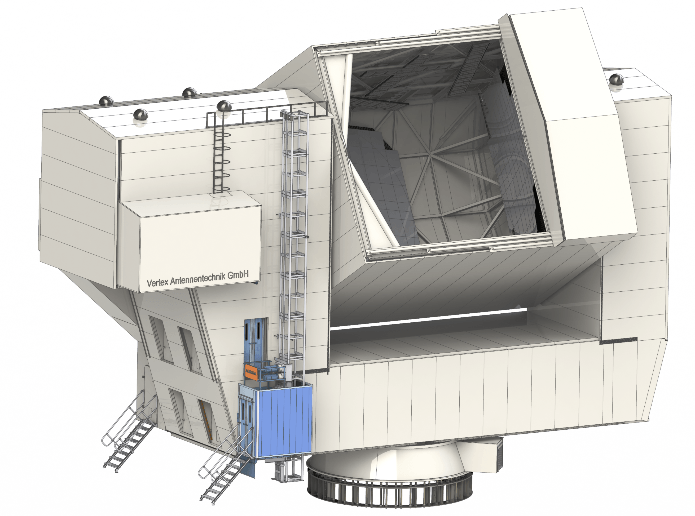 Where the ALMA was designed for a surface accuracy (half wavefront error) of 25 micrometre, the goal for the surface accuracy of the CCAT-p and SOLAT is less than 10 micrometre. Meaning that the mirror surfaces may deform (on average) less than 10 micrometre during operation. To meet these stringent requirements a very stiff and thermally stable structure is required. This is only possible with high-end carbon fibre composites. (Picture: Rendition of the CCAT-prime telescope, Credit: VERTEX ANTENNENTECHNIK GmbH)
 Meeting requirements: high-end composites and automation
Arno van Mourik, CEO of Airborne, says: “Due to a change in temperature normal material expands. In this case we have to design the structures, and in essence the material itself, in a way that there is no deformation due to changes in temperature. To reach extremely high accuracies you also need a very stiff and stable structure, which is only possible with high-end composites. And to make the manufacturing of the composite structures affordable Airborne deploys automated solutions.”
Peter Fasel, MD at VERTEX ANTENNENTECHNIK GmbH: ” Our team is also very proud to be essential part of this great scientific achievement of capturing the black hole. Actually we were involved in building five of the eight telescopes. Only in cooperation with specialized partners we are able to be successful and Airborne is our key supplier for high precision CFRP – Structures.” (Picture: ALMA)
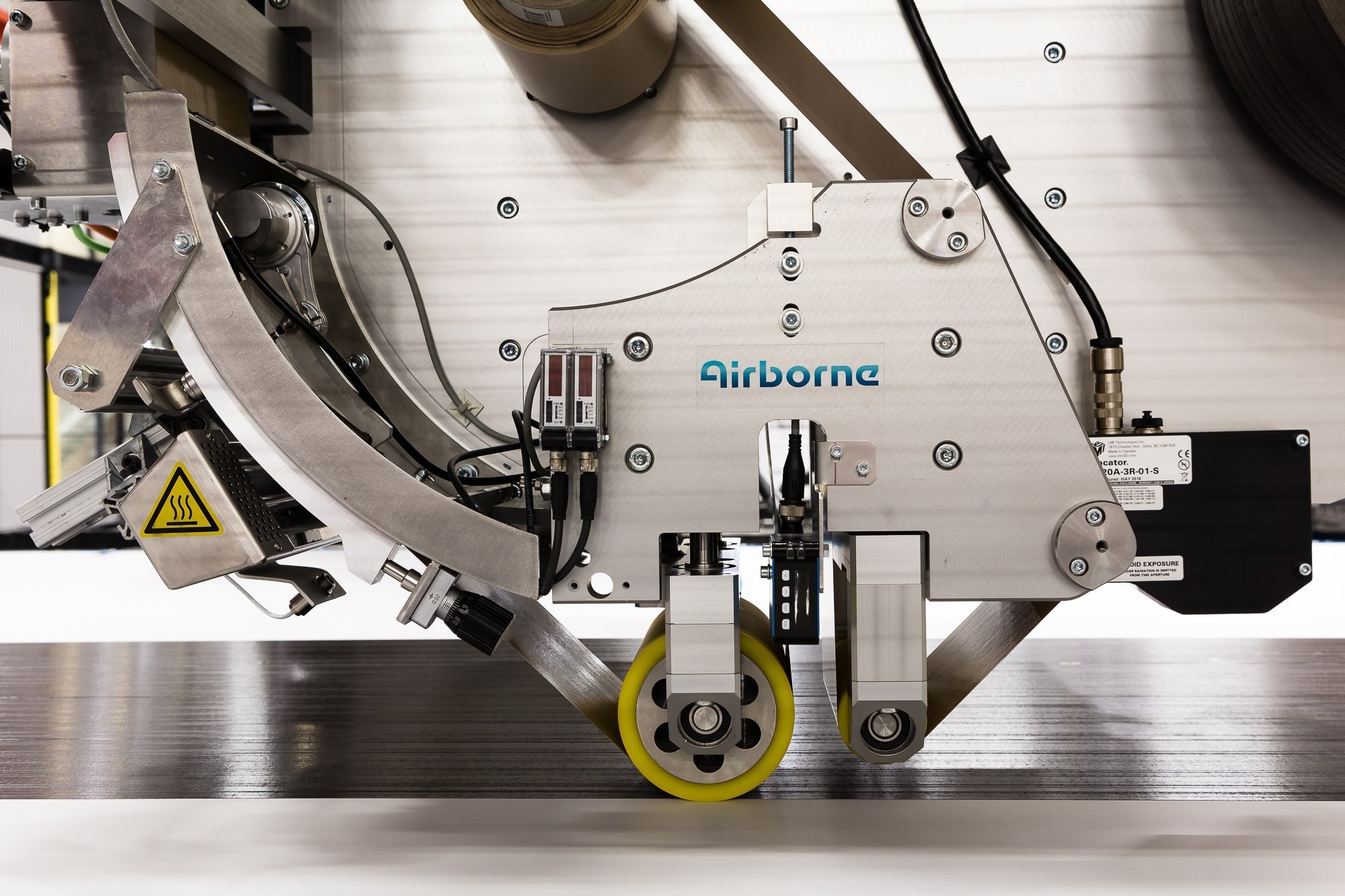 For this project Airborne deploys its Automated Laminating Cell (ALC) solution, featuring automatic tape laying, automatic cutting and automated pick and place. The flexibility of the ALC system makes it possible for one robot to execute the work of three robots making the investment costs much lower than other systems. (Picture: Automated Laminating)
Pushing Boundaries
Airborne and VERTEX ANTENNENTECHNIK GmbH are currently combining their expertise on automated solutions and antennas to establish the design for the Mirror Support Structures of the telescopes. Airborne and VERTEX ANTENNENTECHNIK GmbH plan to start manufacturing the structures in Q4 2019, which will take place in the Airborne facility in Ypenburg, The Netherlands.
Arno van Mourik, CEO of Airborne, says: “We have a good and long standing relation with VERTEX ANTENNENTECHNIK GmbH due to our previous collaboration on the ALMA and SPT telescopes. We are now proud to continue our partnership on the CCAT-prime and SOLAT telescopes. A challenging task, where we are pushing the boundaries of what is possible. We are encouraging the entire supply chain to come up with more accurate materials, improve their products and test for new properties.”
More structures on the way
 With the CCAT-prime and SOLAT project Airborne is contracted to manufacture structures for two new telescopes, but the science community already expressed their interest in expanding their array to have more of the same designs. Through automation Airborne can ensure a fast-paced, affordable and high-quality manufacturing process.
For further information, please contact Sandor Woldendorp, Business Unit Director,
Airborne Aerospace: s.woldendorp@airborne.com