
[vc_row][vc_column][vc_column_text]
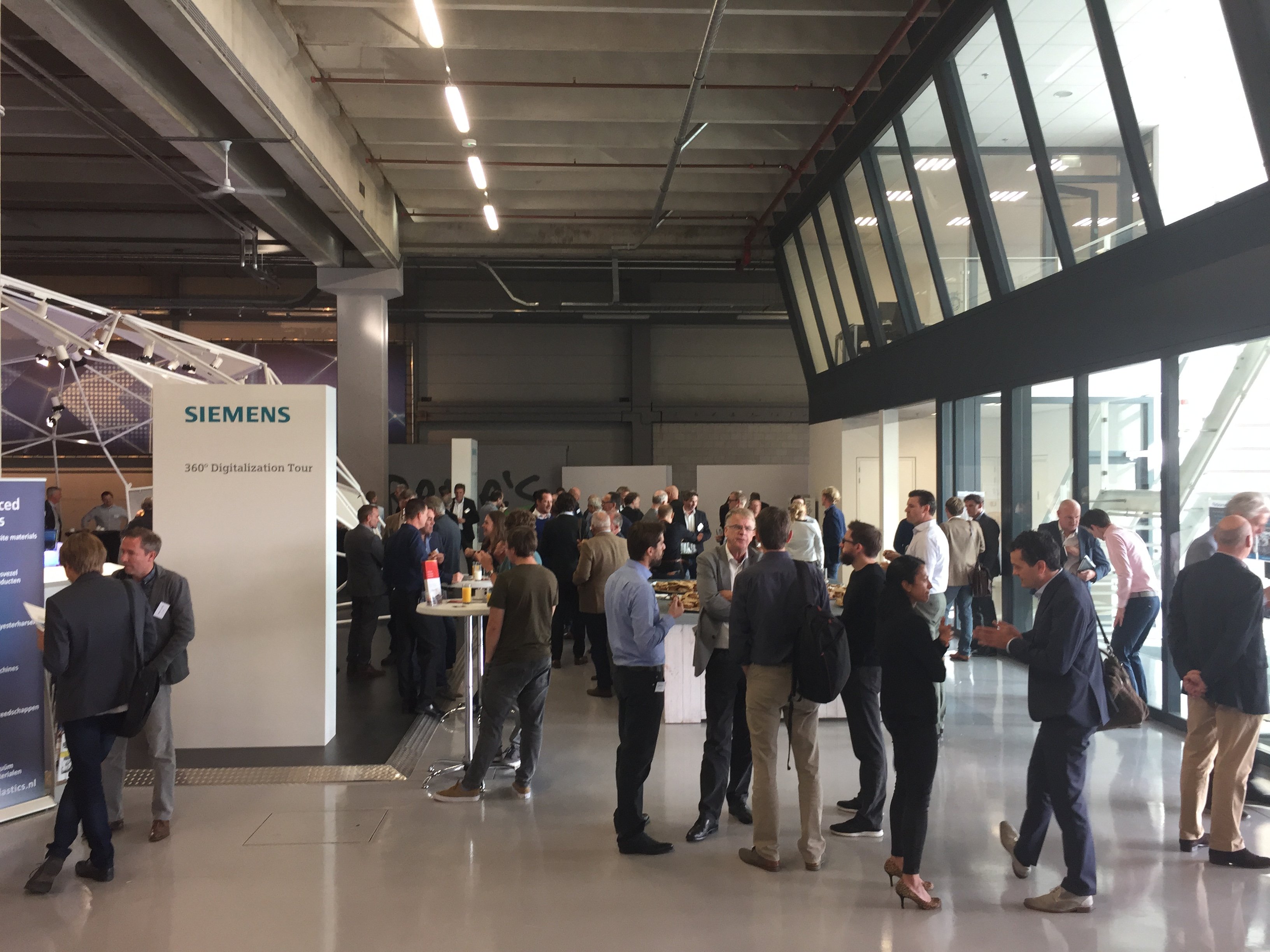
CompositesNL event in the Digital Factory for Composites Fieldlab
Marcus Kremers – Chairman CompositesNL / CTO Airborne
Marcus Kremers opened the event by welcoming the companies and an introduction about CompositesNL itself. CompositesNL is an association that represents the whole composites industry: small and large companies, research institutes, educations and other parties. CompositesNL wants to connect all these companies and institutes to stimulate the use of composites. They hosted a special event to reveal their agenda and to convince other companies to join the association. CompositesNL focuses on three main subjects: promotion, knowhow and regulation.
Promotion of Composites
The first topic is the promotion of composites in general, for example in tradeshows and media coverage, to explain the advantages such as lightweight, no corrosion, better durability and design freedom. This allows the members of CompositesNL to convince their customers to use more composites. CompositesNL also aims to create a whitepaper about the composites industry in the Netherlands, to show the variety of sectors the Dutch composite industry is active in. Since most of the Dutch composite industry works internationally, CompositesNL finds it important to stimulate international exposure. With FME and HTSM, discussions are ongoing to start up a joint workgroup to set the international business agenda. The first step is to clearly define what is so special about the Dutch composites, then to write a strategic plan and based on that plan the international promotion activities such as exhibtions or business trips to target countries will be selected. CompositesNL will host networking events like this annual event at the Digital Factory for Composites fieldlab of Airborne and will develop more opportunities to connect. It also will represent the Dutch composites industry in other events, according to Marcus Kremers.
 Know-how
With regard to the development of know-how through innovation, Marcus Kremers from Airborne highlighted that CompositesNL is not a research platform, but an association that supports all technology development for composites. CompositesNL sees it as its responsibility to be part of these developments, as a channel to voice the needs of the industry and their members. In addition, they want to highlight the innovation funding possibilities, so they can show their members what the possibilities are and will help them set it up. Furthermore, CompositesNL wants to connect internationally to the research centres, networks and organisations in Europe to understand what is happening there and offer these connections to its members.
Know-how is also education and education is important to create enough talent to support the growth of the composites industry. here is a workgroup, called “education” which connects all the educational partners. They are setting up new modules and also writing new books through all the levels.
Regulations
The third pillar is regulations, where the role of CompositesNL is to represent the industry towards the government if changes are being made. There are new regulations about recycling, but also on personnel and environment safety and design codes.
“The main goal of CompositesNL is to connect all parties, to make the composites industry grow and become more profitable.” – Marcus Kremers
Simon Astwood – National Composites Centre (UK)
NCC is the National Composites Centre of the UK, delivering the UK Composites Strategy. NCC is hosted by the University of Bristol, led by the industry and develops technology for the industry. Simon Astwood was speaking about the trends in composites technology, which is much about automation and digital manufacturing, similar to the strategy of Airborne. He explained that these technologies can increase speed and reduce cost, while at the same time increase repeatability. The complexity of the parts can be a challenge in applying automation and novel processes, a careful trade-off is to be made. A remarkable alternative method that NCC is working on, is to use advanced technologies to augment the human laminators to be more precise and repeatable. Although a specialist on automation, Simon does not believe that humans will be fully replaced by robots, but rather that a combination and augmentation will be the most optimal.
Diana Martens – Ministry of Social Affairs & Employment
Diana Martens spoke about the stricter regulations on the use of hazardous substances that is being applied by the government. An interesting aspect is that the Ministry will promote the use of new technologies when these come available, such as robotization which can reduce the risk of exposure to toxic substances to humans,
In a survey over 2016 and 2017, more than 30 composite companies were being audited, of which 87% where not compliant with the regulations. This is a clear sign that the industry needs to improve, and she made the strong suggestion to work together through CompositesNL. Marcus Kremers explained that his exactly why regulations are an important topic of the association, and that work is already on-going. Recently a helpdesk on environmental topics has been installed for its members, and there is a project on-going to create a catalogue of composites related measures that can be taken to improve the working conditions for the workers.
Arnold de Bruijn – Netherlands Maritime Technology
Arnold de Bruijn spoke about the current status of composites in the maritime sector, the ongoing developments that are happening and the future lookout for NMT. The Netherlands Maritime Technology wants to see the use of composites in the maritime sector grow because composites have a lot of advantages compared to other materials that are currently used, such as lightweight, less corrosion and higher performance, and NMT wants to cooperate closely with CompositeNL on this.
An important challenge for the adoption of composites in maritime are the SOLAS regulations. Steps are being taken to allow composites to be used, but these are still focused on structural elements of the ship. The key challenge is to develop a full composites ship, certified under SOLAS. Arnold challenged the Dutch maritime and composite industry to work together to develop such a SOLAS certified composite ship and be the first in the world.
Patryck Wroclawski – Hexagon
Hexagon develops automated machines which will facilitate the quality inspection in the composites industry. They offer composites production companies a tool whereby the measuring can be digitized, for quality control but also for reverse engineering. The novel Apodius sensor has been developed specifically for composites, which can measure in great detail the local fibre orientations in a composite part. These measurements can then automatically be used for quality control but also for engineering simulation. Hexagon showed the sensor with live demonstrations during the breaks.
Tour through Airborne and KVE
At the end of all the presentations, the visitors were invited to take a look inside Airborne and KVE. The tour guides showed the latest technology that Airborne uses on automation. Airborne used to produce composites for solar arrays, fuselages and rotor blades all by hand. As a result of handmade composites, the parts were very expensive. That is the reason why Airborne is currently busy with automating the process of manufacturing composites. Airborne believes that composites can be more affordable for high-end markets such as Aeronautics, Space and Marine.
Combining the latest technology and the expertise of Airborne on the process of manufacturing composites made the tour a very impressive experience.
Space – Next generation advanced composites for space
Airborne Aerospace, Airbus Defence & Space Netherlands and TenCate Advanced Composites have bundled their knowledge. They have developed and qualified the next generation substrate panel technology for satellite solar arrays. The design, materials, processes and tooling of the panel were improved with the main goals being increased process robustness, product performance and cost efficiency.
TenCate Advanced Composites supplies the materials that are used by Airborne to create the substrate panels of the Advanced Rigid Array (ARA) Mk4 solar array system for satellites. Airbus Defence & Space Netherlands developed the ARA Mk4 technology in close cooperation with Airborne and will be deployed on solar arrays for European Space Agency (ESA) missions. The future deployments of the ARA Mk4 technology include the JUICE (JUpiterICy moons Explorer) mission that is planned to launch in 2022 and also the MetOp-SG. The MetOp-SG carries the objective to provide operational observations and measurements from polar orbit for weather predictions and climate modelling and monitoring.[/vc_column_text][/vc_column][/vc_row][vc_row][vc_column][vc_video link=”https://vimeo.com/239440734″][/vc_column][/vc_row]